

Last Thursday, Outlook went down. Friday brought Workday and an FAA ground stop. Monday, banking problems. And by Monday night, researchers had traced malicious code to a website vendor used by some of the biggest brands in the world.
Different causes. Same exposure. Your business can stop taking payments, running payroll, or serving customers because somebody else's system failed.
If you're buying a business, here are five vendor checks to run. If you already own one, print the free 72-hour response playbook below, fill in the phone numbers, and keep a copy somewhere you can find when the internet is down.

~ THE WAVE: The Week Everything Went Down

Illustration
Six days. Five failures. One question: could your business keep operating?
Thursday: Microsoft. Outlook and other Microsoft 365 services went down around the world. Microsoft said it had no indication of a cyberattack. Eric had a more practical concern: "I have 23,642 emails to send and growing."
Friday: Workday and the FAA. A problem in Workday's disaster recovery environment disrupted access for affected customers. Timekeeping, pay access, and benefits enrollment were among the casualties, with recovery running into Saturday. Workday says it was not a cybersecurity event. The same day, an FAA communications failure forced a nationwide ground stop for several hours.
Monday: the banks. Chase acknowledged a "technical issue" as customers reported trouble logging in and moving money. Wells Fargo and Capital One saw complaints too, and some customers reported Zelle problems.
Also Monday. Google's Threat Intelligence Group reported attackers using AI to speed up finding and exploiting software flaws. Eric's take: "Main Street doesn't have an IT department to help defend against and address these issues. Main Street has a guy who has all the passwords written down on a sticky note."

Monday: Optimizely. Researcher Scott Helme identified malicious JavaScript being delivered through the website technology provider's customer projects, and Optimizely confirmed the incident that evening. Helme tied the code to 178 organizations, including Zoom, the BBC, and HSBC. It was built to capture payment and other data typed into affected pages. That does not mean every one of those organizations had a confirmed customer data breach. It means a trusted vendor became the way in.
This was not one coordinated attack. Some of it was plain technical failure. One involved compromised third-party software. For a buyer, the distinction matters less than the dependency. You are acquiring a business that runs on systems you don't own, contracts you may not have read, and recovery plans that may not exist.

Here is what to diligence.
1. Map the dependencies. Get the list of every vendor the business cannot run 24 hours without: payroll, POS, email, CRM, banking, scheduling. Find out who controls each account and whether access transfers at closing. If the answer is "the seller's nephew has the passwords," that is a finding.
2. Read the contracts. Check service levels, liability caps, termination rights, data access, and assignment restrictions. A service credit worth one month of fees will not replace a week of lost revenue.
3. Check the security history. Ask for prior incidents, ransomware events, regulator notices, and claims. Negotiate cyber reps with a lookback period and remedies that fit the actual risk. Find out who manages access, backups, and recovery today.
4. Read the insurance. Does the cyber policy cover losses when a vendor goes down (often called dependent or contingent business interruption)? What are the waiting periods and exclusions? Will the buyer's coverage be in force at closing?
5. Ask about the last outage. How long did it last? Did payroll run? Could customers pay? Who made the calls, and what changed afterward?
A seller who can't answer those questions just handed you another diligence item. Already own the business? Run the same exercise this week.
~ FREE THIS WEEK: Your Business Just Got Hit

Most small businesses don't have an incident response team. They have an owner, a phone, and a problem that gets more expensive every hour.
So we distilled public guidance from CISA, the FBI, and the FTC into a one-page response checklist. It covers cyber incidents and major vendor outages, with different steps for each. Here is the short version. The full printable page is right below it.
Hour 0 to 1: contain. If you suspect an attack, disconnect affected devices from Wi-Fi and the network, but leave them powered on to preserve evidence unless an infection is spreading and you can't isolate it. Move to a phone or channel the attacker can't read. If money moved, call your bank's fraud line now and report it at ic3.gov. Write down what happened and when.
Hours 1 to 24: get help. Call your cyber insurer (many policies require notice and approved vendors) and your lawyer, but don't let paperwork delay urgent containment. Preserve emails, screenshots, logs, and devices. Don't wipe or rebuild anything yet. Keep the essential work moving manually.
Hours 24 to 72: recover and notify. Restore only when your responder says the systems and backups are clean. Reset passwords and turn on MFA. Work out which customer, employee, regulator, lender, and contract notices apply, and remember some deadlines start right away. Make any ransom decision with counsel and law enforcement. Paying does not guarantee you get your data back.
If it's your vendor that went down, not you: confirm it on their official status page, switch to the manual plan, and record the hours and costs for any service credit or claim. Not every outage is a breach.
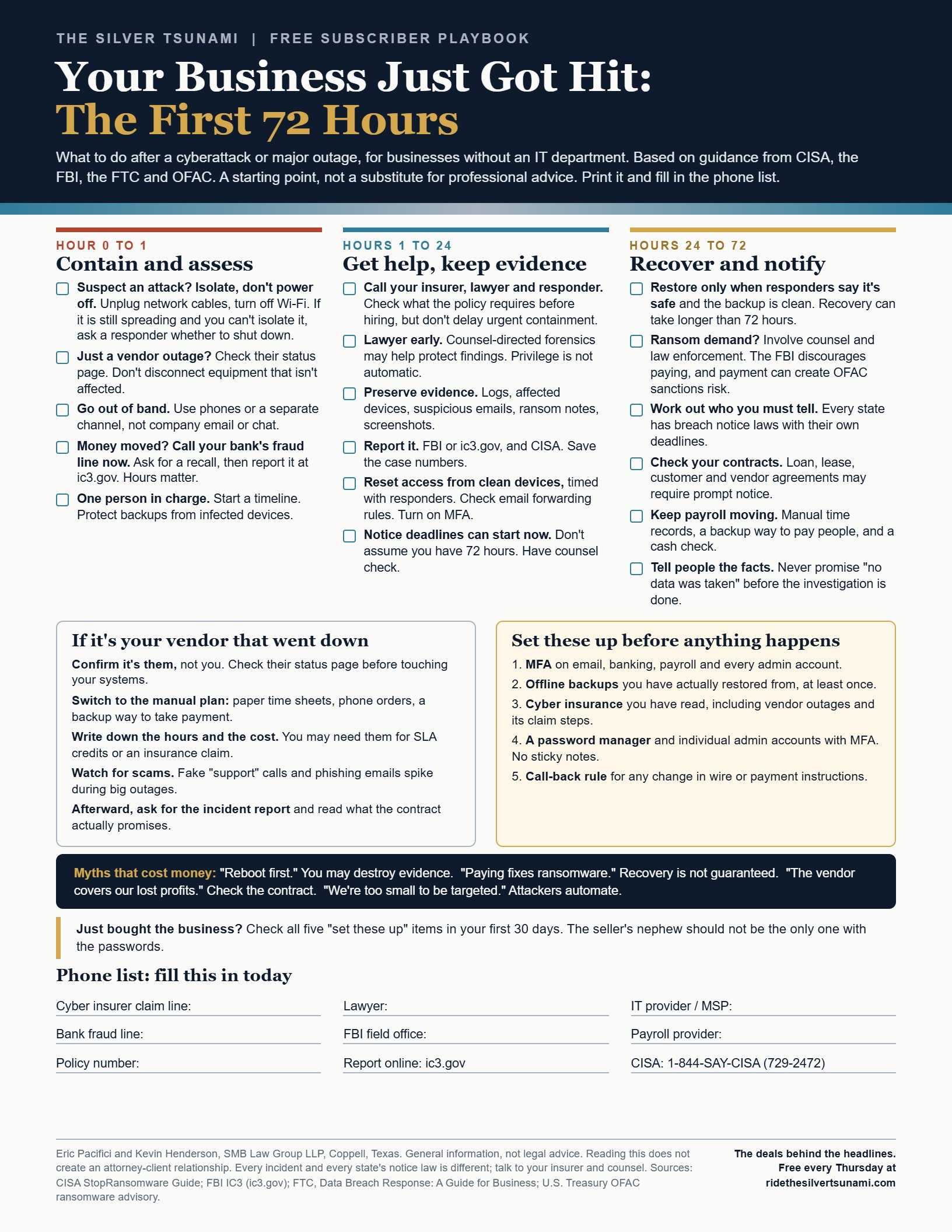
Tap the image to open it full size for printing.
Print it. Put it in the office. Make sure someone other than the owner knows where it is. Then forward this email to another owner. They may need it before you do.
~ SMBASH 2027: Tickets Go On Sale Black Friday
Eight days. SMBash 2027 is April 21-22, 2027 at The Rayleigh Underground in Las Colinas (Irving), Texas. Two days with the searchers, operators, lenders, and investors building this community. Tickets go on sale Black Friday, November 27, per SMBash on LinkedIn. Join the waitlist at smbash.com.

Sponsorships are open: smbash.com/sponsors.
Full disclosure: Kevin and Sam Rosati are co-owners of SMBash.
~ THE CLAUSE: The Working Capital Peg
One provision a week, from people who draft them for a living.

Illustration
A deal can survive three months of diligence and die over one balance sheet item. Searcher Rob Terrin says his did.
Rob closed his search fund in June with a cybersecurity business already under LOI. Three months later he had a full financial model, most of a stock purchase agreement negotiated, and diligence fees "into the six figures."
The deal died over deferred revenue.
The company had sold two- and three-year contracts paid up front, which Rob said equaled 10% to 20% of enterprise value. The seller had collected the cash. The buyer would inherit the obligation to do the work. The LOI said deferred revenue would be treated as debt, but the two sides could not agree on how to apply it. Rob flew out for one last attempt. In his telling, the seller came back with terms that raised the price 20% at the 11th hour. No deal.
Asked what he would do differently, Rob answered: "NOTHING. NADA. ZIP. ZILCH." His reasoning: "diligence is for killing deals that look good but aren't. That's the point!"

Now the legal issue. In many cash-free, debt-free acquisitions, the buyer expects the business to arrive with an agreed level of normal working capital. That target is the peg. If closing working capital comes in below the peg, the price generally goes down. Above it, the price generally goes up. A true-up a few months after closing settles the final number.
But first, the parties have to agree on which assets and liabilities count. Deferred revenue can swing the economics a lot depending on that decision.
Four ways to handle it:
Debt-like. Deduct it from the purchase price, potentially dollar for dollar. Usually the most buyer-friendly answer, and the hardest sell.
Working capital. Include it in both the peg and closing working capital. If balances are steady, the adjustment can be close to neutral, even though the buyer still inherits the work.
Cost to serve. Credit the buyer for the estimated cost of delivering the remaining services, not the full contract price.
Split. Short-term amounts in working capital, longer-term obligations treated as debt.
There is no universal rule. Rob described cost to serve for short-term software obligations and debt treatment for a year or more as his understanding of market practice. The remaining obligations, the accounting, and the deal decide the right answer.

What a buyer should do. Before you sign the LOI, ask for a deferred revenue schedule by customer, contract, and remaining term, and confirm what has actually been collected. Put the treatment in the LOI in plain words. In the purchase agreement, define the peg, attach an illustrative calculation built from the seller's actual accounting, and make sure the same obligation isn't counted twice.
Illustrative LOI language (buyer-favorable): "The Purchase Price assumes Net Working Capital at Closing equals an agreed target. Deferred revenue for services to be performed more than twelve (12) months after Closing, to the extent cash was received before Closing, will be excluded from both the target and Closing Net Working Capital and deducted from the Purchase Price dollar for dollar. All other deferred revenue will be included consistently in the target and Closing Net Working Capital. The parties will attach a customer-level schedule and illustrative calculation to this LOI. No amount will be counted twice."
That is a starting point, not a form, and it is not a claim about what is market. The point is that the economics get spelled out in the LOI instead of left for a later fight. If the issue is big enough to kill your deal, it's big enough to raise before you spend six figures.
~ KEVIN'S READ: The SBA Beat

Your QoE can shrink your SBA loan. For SBA 7(a) applications received by SBA on or after October 1, 2026, SOP 50 10 8.1 requires an independent quality of earnings report for initial acquisitions and qualifying expansions with a business purchase price of $3 million or more, not counting the appraised value of owner-occupied real estate. Owner buyouts, ESOPs, and co-op conversions are treated differently. The lender must use the QoE's earnings in its debt service coverage calculation.
That has a direct cash consequence. Lender Bruce Marks spelled it out: if the QoE doesn't support the valuation and the debt, "the loan amount must be reduced accordingly," and more equity may have to fill the gap. His advice: "Ordering and the timing of your QoE is now vital." Ask your lender before you order one. A seller-prepared QoE won't satisfy the requirement, and a buyer-prepared report may only work with a reliance letter or a secondary independent review, depending on the lender.
Kevin tells clients to "run as much business diligence and QOE before starting to pay me to start legal diligence and draft." Get the financial diligence moving early so you know whether the deal can be financed. Just have counsel review the LOI before you sign it.

And no, the personal guaranty is not easy to avoid. On Tuesday, Blueprintsmb posted that searchers keep asking how to get around a personal guarantee, and the short answer is you can't, unless you do a traditional search fund and own a much smaller share of the economics. Eric agreed: "You can't get around a PG with an SBA-backed transaction. There are dramatic steps that can be taken (like setting up an irrevocable trust) but no one ever actually pursues those options once they understand the implications."
The rules back him up. Anyone owning 20% or more of the borrower, directly or indirectly, generally signs an unlimited guaranty. Spouses' and minor children's interests can be counted together, and at least one unlimited guaranty is required even if no one hits 20%. Trusts are not a loophole either. If one or more trusts together own 20% or more of the borrower, each trust generally has to give an unlimited guaranty, and the trustor has to personally guarantee too, whether the trust is revocable or irrevocable. Lenders can also require more guarantors. If signing personally is a dealbreaker, figure that out before you build your plan around SBA financing.
~ THE LEDGER: Is Your AI Bill an Add-Back?

According to Ramp's October AI Index, 56.8% of U.S. businesses in its customer base paid for AI tools. Anthropic showed up at 44.8% and OpenAI at 40.6%, and the median company paying for AI spent $16.32 per employee per month. AI is becoming a normal operating expense. Which means it is about to show up in a lot of CIMs.

Illustration
Seller: "We spend $40,000 a year on AI tools. That's discretionary. Add it back."
Buyer: If the business uses those tools to do its work, the expense may be necessary to keep earnings where they are. New software is not discretionary just because it's new.
What if AI replaced an employee? Then you need to know whether the savings actually happened, whether the tool keeps doing the work after the seller leaves, and what it costs to maintain.
The bigger trap is projected savings. A seller can't add back the salary of someone they plan to replace with AI and call it historical EBITDA. The test is simple: did the savings actually occur, and will you inherit them? Value the business that exists. Don't pay the seller for an AI upgrade you still have to make.
~ THE SPLIT
We ask three AI models the same question. Yes or no, plus three sentences.
This week's question: Will AI replace the small-business deal lawyer in the next five years?
Why we asked: last weekend, John Caple posted: "Our firm spends over $10M a year on legal fees. Almost all of it on M&A transactions that are all pretty similar." He added that his firm has very few disputes to point to as proof of what that spend bought. It's a fair question. If the documents are similar and the disputes are rare, what are clients actually paying for? Eric's answer: "No one knows what the world will look like in 5 years. But I know (with 100% certainty) it will look very different. Everyone will be impacted. No one is safe."

Grok: NO. "AI will continue to automate document drafting, due diligence checklists, and standard clause analysis for $1 million to $20 million deals, but it will not assume the licensed responsibility, negotiation judgment, or client fiduciary role that defines the lawyer. State bar rules, malpractice exposure, and the need for real-time human assessment of non-standard risks (seller financing quirks, key-person dependencies, state-specific bulk-sale rules) keep a human attorney in the loop. By 2031 the typical small-deal lawyer will therefore still close the transaction, using AI as a high-powered associate rather than being displaced by it."
ChatGPT: NO. "By 2031, AI will draft most routine deal documents, review diligence faster, and make a large share of today's legal work dramatically cheaper. But it will not replace the lawyer who negotiates under pressure, decides which risks justify walking away, and takes responsibility when the advice is wrong. The small-business deal lawyers who survive will sell judgment and accountability, not hours spent producing documents."
Claude: NO. "AI will draft the first version of most purchase agreements, run the diligence checklist, and flag the issues faster than any associate, and buyers should expect to pay less for that work. What it will not do is decide which issue is worth killing a deal over, push back on a seller at the eleventh hour, or carry the malpractice exposure when the advice is wrong. The deal lawyers who survive will be the ones selling judgment, not page count."

Illustration
Our take. Caple is right about the repetitive work. AI will make a lot of it cheaper, and clients should expect those savings. But counting disputes is a poor way to measure legal value. Rob Terrin spent six figures on a deal he walked away from. That doesn't mean diligence failed. Finding the deal-ending problem before closing was the whole point. Spotting deferred revenue is easy. Pricing it, negotiating it, and knowing when to walk are where the real money is. Lawyers who can't tell those decisions apart from document production are going to have a problem.
~ RIPTIDE

A listing isn't a closing. Heather Endresen argues the Silver Tsunami is showing up in listings faster than in closed deals. Her point: owners need to get sale-ready two to three years before they retire. If the business depends entirely on the owner, finding a buyer isn't the only problem.
Those owner salaries aren't all add-backs. A Columbia searcher on Searchfunder described three CIMs that added back pay for every owner and spouse while, in the searcher's view, understating what it costs to replace them. Model the cost of the people who are leaving.

Illustration
Pull the public records before the LOI. Another searcher reviewing a Florida home services listing says public records raised questions about who holds the trade license, lien filings, and the real estate value. The facts still need verifying, but the lesson stands: check the records before you spend money on the seller's version of the story.
Seven steps for a first deal. Mark Edler, who has bought two CPA firms, laid out his: pick an industry, set an earnings floor (he says $500K of EBITDA), check margins, vet the seller, offer a multiple, structure with a seller note or earnout, and get a QoE. His closer: "If the model breaks at the price, the deal breaks at the price."
Succession planning, the hard way. When Nvidia announced Jensen Huang's resignation on November 12, CFO Colette Kress became interim CEO and the board named its first separate chair. If a company that size needs a plan for an abrupt leadership change, so does a $4 million business.
Interest is now a trillion-dollar line item. By Treasury's fiscal 2026 numbers, net interest on the federal debt hit a record $1.05 trillion, behind only Social Security and Medicare. Rates matter to every leveraged buyer.
~ WORK WITH US
For lawyers. We're hiring remote attorneys in Senior M&A, Securities, Employment, Intellectual Property, and Commercial Real Estate. See the openings and apply here.
For buyers, sellers, and HoldCo builders. Under LOI or getting close? Get started here.
~ LISTEN

Buying a Small Business Is Not Passive Income. This week on Main Street Deals, Kevin and Eric take apart a TikTok ad pitching an AI bot as the way to buy a plumbing company, and explain why buying a business is not the passive income play some promoters sell. They also get into the midterms and what divided government could mean for financing and dealmaking.
Watch on YouTube or listen on Apple Podcasts or Spotify.
Print the playbook. Fill in the phone numbers. Forward it to an owner who doesn't have an IT department. Hope none of us needs it.
See you next Thursday.
Eric and Kevin